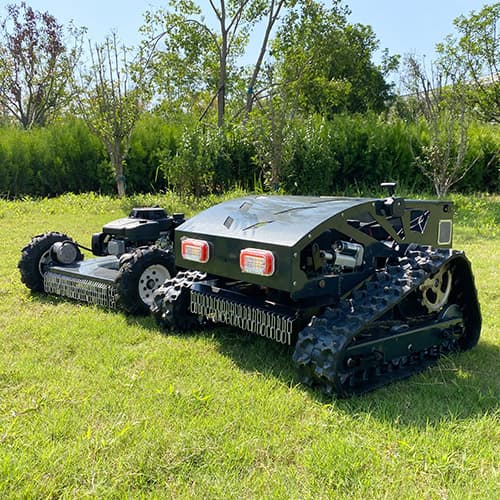

Choosing the right lawn mower sounds simple until the job involves more than a flat backyard. From conversations with our overseas distributors, we find many contractors struggle picking equipment once site conditions move past basic residential lawn work.
For professional landscapers, property maintenance companies, farmers, and contractors, mowing can mean dealing with steep slopes, long grass, uneven ground, large properties, orchards, roadside areas, and difficult‑to‑access spaces.
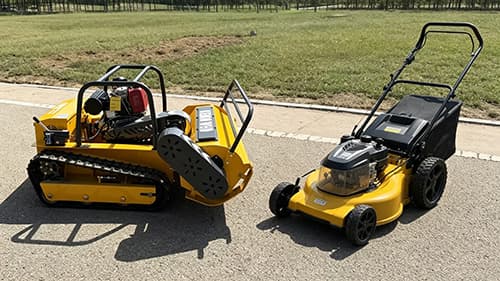
In these conditions, the choice often comes down to two very different types of equipment: a remote control lawn mower or a traditional walk‑behind mower.
Both have their strengths.
A walk‑behind mower is familiar, relatively straightforward, and highly practical for many everyday mowing jobs. A remote controlled mower, on the other hand, is designed to give operators greater freedom when working in challenging environments.
So which one is better?
The honest answer is: it depends on the job.
The better question is which machine can complete your typical work more efficiently, comfortably, and consistently.
Two Mowers, Two Different Ways of Working
The biggest difference between these machines is not necessarily the cutting system.
It is the way the operator interacts with the mower.
With a walk‑behind mower, the operator stays directly behind the machine throughout the job. The operator controls the direction, speed, and mowing path while physically moving with the mower.
A remote control lawn mower works differently.
The operator uses a remote controller and can stand away from the machine while guiding it across the working area.
This changes the entire mowing process.
For a small, flat lawn, the difference may not be significant.
For a steep embankment or rough field, it can be much more important.
Walk‑Behind Mowers: Where They Still Make Sense
Walk‑behind mowers remain one of the most common types of lawn mowing equipment for good reason.
They are familiar to operators and can be highly practical for smaller properties and areas where maneuverability is more important than specialized terrain capability.
A walk‑behind mower can be a good option when:
The ground is relatively flat
The mowing area is small or medium‑sized
Grass is regularly maintained
The operator needs close control
The site has narrow passages
The equipment needs to be simple to transport
For residential gardens and straightforward landscaping work, there may be little reason to choose a remote controlled machine.
A conventional walk‑behind mower can get the job done effectively.
The situation changes when the terrain becomes more demanding.
Where Remote Control Mowers Have an Advantage
A remote controlled mower is designed around a different set of problems.
Instead of keeping the operator directly behind the machine, it allows the mower to be controlled from a distance. One vineyard owner in France told us this removed a lot of physical strain for crews working year‑round on sloped ground.
This is particularly interesting for professional applications involving:
Slopes
Embankments
Rough grass
Overgrown areas
Orchards
Commercial properties
Roadside vegetation
Uneven terrain
Imagine a contractor maintaining a long grass embankment.
With a walk‑behind mower, the operator needs to follow the machine along the slope.
With a remote control mower, the operator can stand in a suitable position and guide the machine remotely.
That difference can make challenging mowing work feel like a completely different task.
The Terrain Test
If you are trying to decide between the two, start with one question:
What does your typical terrain look like?
This is often more useful than comparing engine specifications or purchase prices. When customers come to our factory, our engineers start with site terrain rather than horsepower numbers.
| Working Condition | Walk‑Behind Mower | Remote Control Lawn Mower |
|---|---|---|
| Flat residential lawn | Excellent | May be unnecessary |
| Small garden | Excellent | Usually more than needed |
| Large flat area | Good, depending on mower | Can be suitable |
| Uneven ground | Depends on conditions | Strong application potential |
| Steep slopes | More challenging | Particularly useful |
| Rough grass | Depends on model | Suitable for demanding applications |
| Orchards | Can work in some layouts | Useful where remote operation improves access |
| Embankments | More difficult | Strong application |
| Difficult‑access areas | Operator must remain with machine | Operator can control from a distance |
The more challenging the terrain becomes, the more valuable remote operation can be.
Operator Position Changes Everything
This is one of the most important differences between the two machines.
With a walk‑behind mower, the operator and machine move together.
With a remote control mower, they do not have to.
That means the operator can choose where to stand based on the job.
For example, if a mowing area contains an uneven section, the operator can position themselves where they have a clearer view of the mower.
If the machine is working around an embankment, the operator can control it remotely rather than following directly behind it.
This flexibility is one of the strongest reasons professional users consider remote control mowing equipment.
It is not simply about convenience.
It changes the working position.
Which One Is More Efficient?
Efficiency depends heavily on the application.
For a small flat lawn, a walk‑behind mower may be faster simply because it is simple to deploy and operate.
There is little benefit in using specialized equipment when the job does not require it.
But difficult terrain tells a different story.
If a contractor regularly works on slopes, rough grass, or awkward areas, a remote control mower may make the working process more practical.
Instead of adapting a standard mower to difficult conditions, the contractor can use equipment specifically suited to that type of work.
The key is not maximum speed.
The key is matching the machine to the job.
What About Cutting Performance?
Cutting performance should always be considered alongside terrain capability.
A mower needs to do more than move across the ground. It must also cut the vegetation effectively. During our field‑testing records, we see mobility does not always equal good cutting results.
For buyers comparing a remote control mower and a walk‑behind mower, consider the type of grass and vegetation being handled.
Short, regularly maintained lawn grass is very different from:
Long field grass
Dense vegetation
Overgrown areas
Rough grassland
Mixed vegetation
If your work involves demanding vegetation, look at the mower’s cutting system and intended application rather than assuming one type of mower will perform equally well everywhere.
Maneuverability: Which Mower Wins?
This is where the answer becomes less obvious.
Walk‑behind mowers can be highly maneuverable in small spaces because the operator is directly controlling the machine.
They can be useful around garden features, narrow paths, and areas where frequent small adjustments are required.
Remote control mowers can also offer excellent maneuverability, but their biggest advantage is the ability to control the machine from a different position.
For orchards, rough terrain, and large outdoor areas, this can be valuable.
The best option depends on the layout of the property.
Maintenance and Everyday Practicality
Another important consideration is maintenance.
A professional mower needs to be inspected, cleaned, serviced, and maintained regularly.
Walk‑behind mowers have a relatively familiar maintenance process, and many operators already understand their basic service requirements.
Remote control mowers contain additional control and electronic components, so buyers should pay attention to technical support and parts availability. Inside our factory, we intentionally arrange service points for easy access to cut down on maintenance time for end‑users.
When comparing equipment, ask:
Are replacement parts readily available?
Is technical support provided?
How easy is routine maintenance?
Can operators access key service points?
Is the machine designed for professional working conditions?
The cheapest machine at the time of purchase may not always be the most economical choice over several years.
Initial Price vs. Long‑Term Value
Purchase price naturally matters.
However, professional buyers should consider the complete operating picture.
A walk‑behind mower may have a lower initial cost, making it attractive for smaller operations.
A remote control mower may represent a larger investment, but its value can be different if it allows a contractor to take on difficult jobs that would otherwise require additional equipment, more manual work, or alternative methods.
| Cost Consideration | Walk‑Behind Mower | Remote Control Lawn Mower |
|---|---|---|
| Initial investment | Often lower | Generally higher |
| Simple mowing jobs | Very practical | May be unnecessary |
| Difficult terrain | May require more effort | Designed for specialist applications |
| Operator flexibility | Limited by direct operation | Higher |
| Specialist job potential | Depends on model | Strong |
| Long‑term value | Strong for conventional mowing | Strong when used for suitable applications |
The right investment depends on how the machine will be used.
Which Mower Is Better for Professional Landscapers?
For a landscaping company, the answer may actually be both.
A professional equipment fleet does not need to rely on one machine for every situation.
A walk‑behind mower can handle smaller lawns, detailed areas, and straightforward maintenance.
A remote control lawn mower can be brought in when the job involves slopes, rough terrain, embankments, or other demanding conditions.
This approach gives contractors more flexibility.
Instead of asking which machine should replace the other, it may be better to ask:
Which machine should we use for each type of job?
That is a much more useful question for a professional business.
When a Walk‑Behind Mower Is the Better Choice
Choose a walk‑behind mower when your work is mainly:
Flat
Small or medium‑sized
Regularly maintained
Easy to access
Focused on detailed mowing
For these applications, the simplicity of a walk‑behind mower can be a major advantage.
There is no reason to use specialized equipment when the job does not require it.
When a Remote Control Lawn Mower Makes More Sense
A remote control lawn mower becomes more attractive when your work regularly includes:
Steep slopes
Uneven terrain
Rough fields
Long or dense grass
Embankments
Orchards
Difficult‑access areas
Large commercial properties
In these environments, the ability to operate the machine remotely can provide a significant practical advantage.
The KOIVI Approach
KOIVI focuses on remote control lawn mowers designed for professional outdoor applications.
The machines are developed around a simple idea: difficult mowing conditions require equipment designed specifically for those conditions.
For contractors and businesses working on slopes, rough grass, orchards, embankments, and other challenging terrain, remote operation provides another way to approach the job.
KOIVI remote control lawn mowers are not intended to make every conventional mower obsolete.
Instead, they provide professional users with another tool. If you would like to compare which unit fits your job scenarios, you can get connected via WhatsApp.
The right machine is ultimately determined by the work.
A Quick Decision Guide
If you are still unsure which type of mower to choose, use this simple guide:
Mostly flat lawns?
A walk‑behind mower may be the most practical option.
Small areas with lots of detail work?
A walk‑behind mower is likely to be easier.
Regularly mowing steep slopes?
A remote control lawn mower deserves serious consideration.
Working with rough grass or difficult terrain?
Look at specialized remote controlled equipment.
Running a landscaping business with different types of jobs?
Consider using both types of machines as part of a wider equipment fleet.
Frequently Asked Questions
Is a remote control lawn mower better than a walk‑behind mower?
Neither is universally better. A walk‑behind mower can be ideal for flat, smaller areas, while a remote control lawn mower can offer major advantages for slopes, rough terrain, and difficult‑access areas.
Are remote control mowers suitable for professional landscaping?
Yes. They can be particularly useful for landscaping contractors and grounds maintenance teams working on challenging terrain.
Are walk‑behind mowers still useful for professionals?
Absolutely. Walk‑behind mowers remain practical for many small, flat, detailed, and easily accessible mowing applications.
Which mower is better for steep slopes?
A remote control lawn mower is generally more suitable for applications involving challenging slopes, provided the specific machine is designed for the terrain and operated according to the manufacturer’s guidelines.
Is a remote control mower more expensive?
The initial investment can be higher than a conventional walk‑behind mower. However, the overall value depends on the type of work, productivity requirements, and terrain where the machine will be used.
Can a landscaping company use both?
Yes. Many professional businesses can benefit from having different machines for different jobs. A walk‑behind mower can handle conventional work, while a remote control mower can be used for difficult terrain.
So, Which One Should You Choose?
There is no universal winner.
If your business mainly maintains flat lawns and smaller properties, a walk‑behind mower may be all you need.
If your work involves slopes, rough terrain, dense vegetation, embankments, orchards, or difficult‑access areas, a remote control lawn mower may offer a much more practical solution.
For professional landscapers, the smartest approach is often to think beyond a simple “either‑or” decision.
Use conventional equipment where it works best.
Use remote controlled equipment where it provides a real advantage.
That is where modern mowing technology becomes valuable—not because it replaces everything that came before, but because it gives professionals a better option when the terrain gets difficult.
The best lawn mower is not the one with the most features. It is the one that makes your actual job easier to complete.