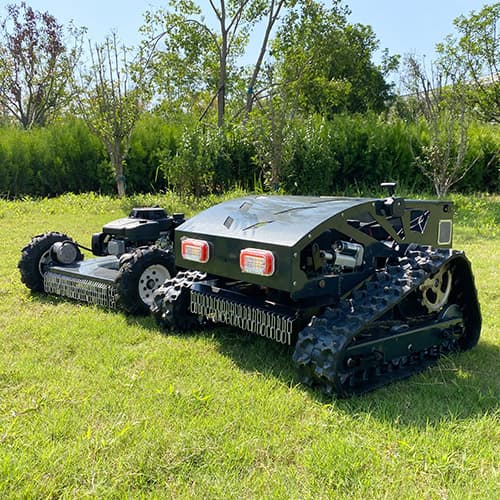

Why Steep Slopes Change the Mowing Equation
Mowing a steep slope is not the same job as mowing a flat lawn.
The terrain changes how the machine moves, how the operator works, and how efficiently the grass can be maintained. Uneven ground, changing gradients, wet grass, loose soil, and obstacles can all make conventional mowing more demanding. From our after‑sales records, we see that slope‑related wear patterns show up much earlier than flat‑ground use — track tension, bearing seals, and chassis stress points all take a beating on inclines.
For professional landscapers, contractors, municipalities, agricultural operators, and property managers, choosing the right machine starts with understanding the site rather than simply comparing horsepower or cutting width.
This is where a remote control mower can offer a different approach.
A remote controlled mower allows the operator to control the machine from a distance instead of walking directly behind it. On suitable slopes, this can create a more practical working position while giving the operator a clear view of the mower and the terrain.
But not every remote control lawn mower is equally suitable for steep slopes. The best choice depends on several factors, including traction, stability, machine design, cutting performance, control, and the actual conditions of the property.
Start With the Slope, Not the Specification Sheet
Before choosing a remote control mower for slopes, look carefully at the terrain.
A short, dry grass bank presents a different challenge from a long embankment covered in tall vegetation. A firm agricultural slope is different again from a wet roadside area with loose soil.
The machine needs to match the environment where it will actually work. When customers visit our factory, our engineers always start with site photos and slope measurements before talking about engine size or deck width.
Professional buyers should consider:
Slope angle
Ground condition
Vegetation type and density
Surface moisture
Obstacles and access routes
How frequently the area needs maintenance
A machine that performs well in one type of terrain may not be the ideal choice for another. This is why application‑based selection is more useful than choosing a mower based only on a single specification.
The Five Features That Matter Most on Slopes
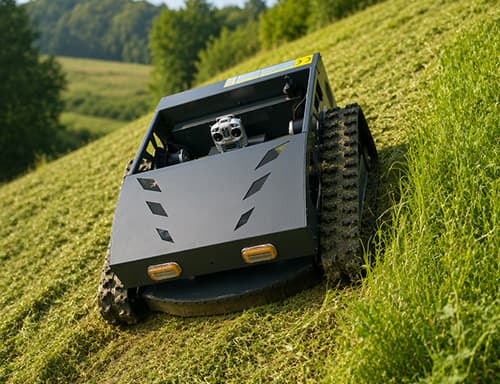
When evaluating a remote control mower for steep terrain, five areas deserve particular attention.
1. Traction
Good traction is essential when a mower is operating on an incline. The machine needs to maintain controlled movement instead of losing grip when travelling across or along a slope. After testing on steep roadside slopes, we found that track width and tread pattern matter more than raw horsepower — a 20‑horsepower machine with proper tracks will outclimb a 25‑horsepower wheeled unit on wet grass every time.
Track systems or other terrain‑focused drive designs can be especially useful where ground contact and grip are important.
2. Stability
Stability is closely connected to the mower's overall design. A low and well‑balanced machine can be easier to control on uneven ground. Before shipment, every unit goes through a tilt‑table test in our factory to verify its center of gravity and stability at the rated slope.
The center of gravity, machine width, weight distribution, and undercarriage design all influence how the mower behaves on a slope. A heavy machine is not automatically stable — what matters is where that weight sits.
3. Cutting Performance
Steep terrain is often associated with rough or overgrown vegetation. A mower therefore needs enough cutting capability for the grass and vegetation found on the site.
Cutting width matters too. A wider cutting system may improve productivity on open slopes, while a more compact machine can be easier to maneuver around obstacles. One of our Canadian customers working on highway embankments told us they prefer a moderate deck width — wide enough for productivity, narrow enough to navigate guardrail posts and drainage culverts.
4. Remote Control Performance
The remote control system is more than a convenience feature. The operator needs precise control over direction, speed, and mowing functions. During our quality inspection, we intentionally kill the signal at maximum range to verify the fail‑safe engages within two seconds — this is not a feature we leave to spec sheet claims.
Responsive controls can make it easier to position the mower accurately and adjust its movement as the terrain changes. On a 45‑degree face, a half‑second delay in control response can mean the difference between a clean pass and a recovery job.
5. Durable Construction
Professional slope mowing can be demanding on equipment. Stones, dust, moisture, vibration, and repeated operation on uneven surfaces can all place additional stress on the machine.
A professional remote control mower should therefore be designed for regular outdoor use and straightforward maintenance. One thing we frequently notice from service records: machines with welded steel frames survive the sliding impacts of loose rock far better than stamped or bolted frames, which tend to crack exactly where the track mounts attach — the last place you want a failure on a slope.
Why Operator Position Matters
One of the strongest reasons professionals consider remote control mowing equipment is the change in operator position.
With a traditional walk‑behind mower, the operator remains physically connected to the machine throughout the task. On a difficult slope, that can increase fatigue and make the working position less convenient. A landscaping contractor from Europe shared that crew fatigue on repeated slope assignments was a persistent pain point before they adopted RC equipment — operators were exhausted by mid‑shift and productivity dropped off accordingly.
With a remote control mower, the operator can stand at a suitable observation point while controlling the machine. This can be particularly useful when mowing embankments, large grass banks, rough terrain, or areas where maintaining a comfortable position behind the machine is difficult.
Remote operation does not remove the need for training or safe working practices. Operators still need to understand the machine's limitations, assess the terrain, maintain visibility, and follow the manufacturer's instructions.
Track Drive vs. Conventional Wheels
For slope mowing, the drive system deserves close attention.
Tracked remote control mowers can provide a large contact area with the ground and are often designed with challenging terrain in mind. Wheel‑based machines can also perform effectively in appropriate conditions, particularly where the ground is firm and the slope is moderate.
The right choice depends on the site. Track design, tread pattern, machine weight, ground pressure, and drive performance can all influence traction.
Instead of assuming that one drive system is always better, professional buyers should compare the machine with the terrain they actually maintain. Several of our distributor partners report that customers who work primarily on firm, dry slopes sometimes prefer wheeled units for speed, while those dealing with wet grass or loose soil almost always go tracked.
The Vegetation Matters as Much as the Gradient
A steep slope covered in short grass may be relatively straightforward compared with a less steep area filled with tall, dense vegetation.
Vegetation changes the cutting load and can affect machine productivity. Thick grass, weeds, brush, and seasonal growth may require a mower with stronger cutting performance and a suitable deck design.
For contractors, this is an important point. A machine selected only because it can operate on an incline may not necessarily be the best machine for the complete job.
The best remote control mower should handle both the terrain and the vegetation. During field testing, we have seen machines with excellent climb capability struggle with thick brush because the deck was designed for manicured turf rather than wild growth.
Choosing the Right Machine for Different Slope Applications
Different professional users have different priorities.
For roadside and embankment maintenance, remote operation, stability, visibility, and terrain capability may be the main concerns.
For orchards and plantations, maneuverability and machine dimensions may become more important because the mower needs to work around trees and other obstacles. A vineyard owner in France told us that compact dimensions mattered more than maximum cutting width — they needed a machine that could fit between rows without damaging vine trunks.
For large commercial properties, productivity and transport can have a greater influence on the buying decision.
For agricultural land management, durability, cutting performance, and the ability to handle rough vegetation may be especially important.
The Best Mower Is Not Always the Largest Mower
There is a natural temptation to choose the biggest or most powerful machine available.
That is not always the best approach.
A larger mower may deliver strong productivity on open terrain, but a compact remote controlled mower can be more useful where access is restricted, slopes are irregular, or obstacles are common.
The right machine is the one that balances terrain capability with productivity and maneuverability.
Professional users should also consider transport. If a mower needs to travel between multiple customer sites every week, loading, unloading, machine dimensions, and overall mobility can have a major impact on daily efficiency. Several of our European distributor partners report that some buyers overlook trailer dimensions before ordering — a machine that fits the slope but not the trailer creates a whole new set of problems.
Think About the Whole Cost of Ownership
The purchase price is only one part of the decision.
For a professional business, maintenance, fuel or energy use, replacement parts, downtime, transport, and operator productivity all contribute to the long‑term cost of equipment.
A mower that costs slightly more but is better suited to the terrain may deliver stronger value if it completes difficult jobs more efficiently and spends less time being pushed beyond its intended application.
This is particularly important for contractors who use their equipment throughout the working season. Downtime on a slope job is expensive — not just in repair costs, but in crew hours lost while the machine is out of service.
Where KOIVI Fits Into the Picture
KOIVI focuses on remote control mowing solutions designed around real professional working conditions.
The company's approach is based on the idea that a remote control lawn mower should be more than a machine with a remote. It should be practical equipment for challenging outdoor environments where terrain, vegetation, and productivity all matter.
For professional users considering a KOIVI remote controlled mower, the most useful starting point is the job itself: identify the terrain, understand the vegetation, estimate the required productivity, and then select a machine that fits those conditions.
That approach helps ensure the equipment is working within a suitable application rather than being chosen simply because of a headline specification. If you would like to walk through your specific slope requirements with our engineering team, you can get connected via WhatsApp.
A Practical Buyer Checklist
Before purchasing a remote control mower for steep slopes, review these questions:
What is the typical slope angle and surface condition?
Is the ground firm, wet, loose, rocky, or uneven?
What type of vegetation needs to be cut?
How tall and dense is the vegetation?
How much area must be maintained?
Is traction or maneuverability the bigger priority?
How far does the operator need to stand from the machine?
How will the mower be transported between sites?
How easy are routine maintenance tasks?
Will the mower be used occasionally or every working day?
Frequently Asked Questions
1. What is the best remote control mower for steep slopes?
The best model depends on the slope, ground condition, vegetation, and required productivity. Key characteristics include strong traction, stable machine design, precise remote control, suitable cutting performance, and durable construction. There is no single universal winner — the right machine matches the specific site conditions.
2. Are tracked remote control mowers good for steep terrain?
Tracked machines can be well suited to challenging terrain because their track systems provide substantial ground contact. However, suitability still depends on the machine design and the actual working conditions. Track width, tread pattern, and ground pressure all play a role — not all tracked machines are equal on slopes.
3. Can a remote control mower cut tall grass on slopes?
Many professional remote control mowers are designed for demanding vegetation. The correct choice depends on the cutting system, machine power, vegetation density, and terrain. A flail‑type deck typically handles tall, tangled growth better than a standard rotary deck designed for manicured turf.
4. Why use a remote control mower instead of a walk‑behind mower on a slope?
Remote operation allows the operator to control the machine from a more suitable position rather than walking directly behind it. This can be valuable on difficult slopes and uneven terrain, reducing operator fatigue and improving visibility of the working area. The operator can stand on stable ground while the machine handles the incline.
5. What should contractors consider before buying a slope mower?
Contractors should consider terrain capability, traction, stability, cutting width, vegetation type, remote control range, transport, maintenance, durability, and total operating value. It is also important to verify the manufacturer's published slope rating with a live demonstration on a true incline, not just a flat lawn test.
Final Thoughts
The best remote control mower for steep slopes is not simply the machine with the highest power or the largest cutting deck.
It is the machine that fits the actual job.
Look at the terrain first. Then consider vegetation, traction, stability, control, productivity, transport, and maintenance. When these factors are matched correctly, remote mowing equipment can become a highly useful tool for professional land management.
For landscaping contractors, agricultural operators, municipalities, and property managers, the move toward remote controlled mowing is about more than technology. It is about finding a better way to manage difficult ground while keeping professional work practical and efficient.
KOIVI is developing remote control mower solutions with this real‑world approach in mind—helping professional users take on challenging mowing applications with equipment designed for control, flexibility, and demanding outdoor work.
Choose the terrain first. Understand the vegetation second. Then choose the remote control mower that is built for both.
Slope Mowing: What to Prioritize
| Working Condition | Priority | Why It Matters |
|---|---|---|
| Steep, firm slope | Traction + stability | Supports controlled movement on an incline. |
| Wet or uneven ground | Ground contact + stability | Helps maintain predictable movement in changing conditions. |
| Tall, dense vegetation | Cutting performance | Handles a higher cutting load. |
| Large open embankment | Productivity + cutting width | Helps cover more area efficiently. |
| Narrow or obstructed area | Maneuverability | Helps work around trees, structures, and obstacles. |
| Multiple job sites | Transport + durability | Supports repeated professional use across locations. |