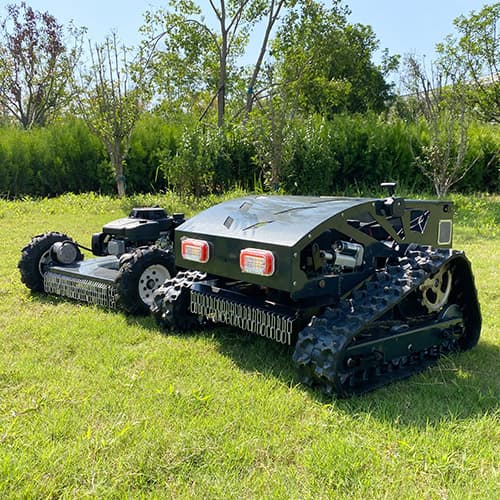

Why Slope Mowing Requires a Different Approach
Mowing a flat lawn is relatively straightforward. Maintaining a steep embankment, roadside slope, drainage bank, or uneven piece of land is a very different task.
On sloped ground, the operator has to simultaneously evaluate terrain, traction, visibility, machine movement, vegetation, and shifting surface conditions. Wet grass, loose soil, stones, ruts, and hidden obstacles can drastically raise job‑site hazards. This growing safety concern is one major factor pushing professional landscaping and land‑management teams toward tracked remote control mower solutions for incline work.
A remote control mower allows the operator to control the machine from a distance instead of remaining directly behind it. For suitable applications, this reshapes the interaction between operator and terrain and delivers a more practical workflow for difficult mowing assignments.
Safety is not the sole reason professionals adopt remote‑controlled equipment, yet it weighs heavily in purchasing decisions for slope‑heavy projects.
The Operator's Position Can Change the Job
When operating a conventional walk‑behind mower, the operator follows closely behind the unit through the full mowing cycle. On slopes, this means the operator is also exposed to the same slippery, unstable ground the machine travels over.
Remote operation establishes an entirely different working setup.
Operators can stand on stable ground with unobstructed sightlines while guiding the mower via wireless controller. This workflow proves especially valuable for embankments, steep roadside verges, rough grassland, and sites where walking alongside mowing equipment creates unnecessary risk. Compact models such as mini tank mower also deliver this positional advantage for smaller sloped sites.
An important reality: remote control technology does not automatically make every slope completely safe. The machine must still be operated within factory‑specified limits, and operators need solid site‑assessment knowledge.
What remote operation truly transforms is operator placement and how slope‑mowing tasks are managed.
What Makes a Slope Challenging?
Slope angle represents only one piece of the risk puzzle.
Two sites with nearly identical gradient can behave completely differently. One may feature firm, dry soil and short turf; another could have saturated earth, thick vegetation, scattered rocks and bumpy surfaces.
Professional operators must evaluate the complete working environment before starting work.
Key evaluation points:
Slope gradient and travel direction
Ground firmness and surface moisture
Grass height and vegetation density
Stones, branches and other field obstacles
Drainage channels and uneven ground patches
Operator visibility from observation position
Site access and emergency escape routes
Weather and shifting surface conditions
Manufacturer‑published machine operating limits
This holistic site evaluation explains why selecting professional remote‑control mowers should start with jobsite analysis, rather than merely comparing marketing‑focused specification sheets.
Traction and Stability Come First
A remote‑control mower deployed on slopes requires predictable, controlled movement at all times.
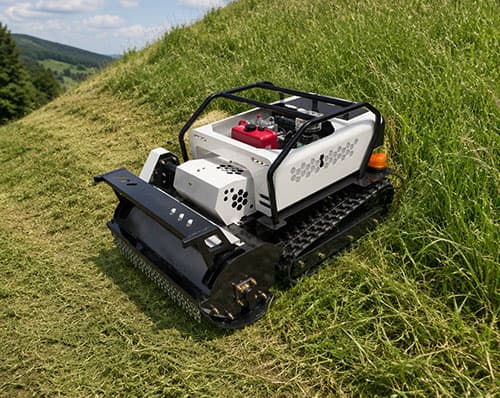
Traction maintains reliable ground contact, while stability governs machine reactions when travelling across uneven or inclined terrain. Track systems, tread pattern, weight distribution, ground clearance and overall chassis construction collectively determine real‑world slope performance.
For buyers, the critical question is not whether a unit is labelled as a slope mower. It is whether its mechanical design matches the actual field conditions your crews encounter day‑to‑day.
Professional operators should consistently follow manufacturer‑stated operational boundaries and recommended slope‑work procedures. A properly‑suited machine aligns with real‑world site requirements, and should not be selected purely around high horsepower or oversized cutting decks.
Remote Control Is More Than a Convenience Feature
Remote operation is sometimes dismissed as a comfort‑oriented extra. For difficult sloped ground, however, it reshapes the full operational workflow.
Operators stay within clear line‑of‑sight observation zones and eliminate the requirement to traverse every hazardous patch of terrain alongside the mower.
This operational model delivers tangible value on sites including:
Grass embankments
Roadside slopes
Drainage management zones
Rough‑surface commercial properties
Orchards and plantations
Large private estates
Construction and redevelopment sites
Overgrown neglected land parcels
Actual benefits hinge on machine capability, site characteristics and standard operating procedures. Remote control forms one component of complete safety and productivity planning; it cannot substitute for hands‑on operator training and thorough site assessment.
A Safer Workflow Starts Before the Machine Moves
High‑safety slope mowing workflows begin before the cutting deck engages.
Professional teams need to complete site inspections, flag visible hazards, map terrain risks and confirm that the selected machine is fit‑for‑purpose for that specific jobsite.
Mowing routes also deserve advance planning. Operators must establish permitted travel zones, no‑go areas, and stable observation points preserving continuous visibility of the mower unit.
Weather drastically alters field conditions. A slope that presents manageable risk during dry conditions can turn extremely hazardous immediately after rainfall.
Experienced land‑management crews treat site assessment as a core work step, not an optional add‑on task.
Choosing a Remote Control Mower for Slope Work
No single technical specification alone determines whether a remote‑control lawn mower will perform reliably on a given slope.
Professional purchasers need to evaluate multiple factors in combination: terrain suitability, traction, chassis stability, remote‑controller responsiveness, cutting performance, build durability, service requirements and transport logistics.
Optimal equipment selection prioritizes matching hardware to real‑world working environments. Selecting a unit exclusively based on high power output can lead to frustration if track geometry, stability ratings or operational limits conflict with field conditions.
Why Cutting Performance Still Matters
Safety and cutting efficiency are tightly interconnected for slope‑mowing operations.
A mower struggling against dense brush requires repeated passes across inclines, extending the total time the machine operates on risky sloped ground. Well‑matched cutting hardware lets crews finish assignments faster and reduce exposure to slope hazards.
Vegetation profiles should therefore be weighed alongside terrain risk assessments. Short turf, tall grass, weeds, brush and seasonal overgrowth all impose distinct cutting loads.
Professionally‑oriented remote‑control mowers should be selected around the vegetation types crews regularly encounter. This practice also prevents operating equipment outside its intended design envelope.
From Safety to Business Efficiency
Slope‑mowing safety carries tangible business consequences for landscaping and vegetation‑management contractors.
Conventional mowing on difficult inclines consumes extra working hours and may force businesses to assign additional staff purely to manage hazardous sites, directly inflating labor expenditure.
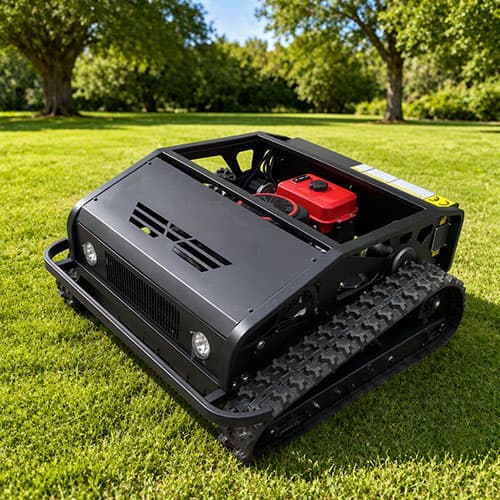
Remote‑control mowing technology offers an alternative operational model. Operators stay positioned on safe ground while guiding the mower across slopes, making tough assignments more manageable.
Realized productivity gains vary depending on terrain, machine model, vegetation density, operator skill and workflow setup. Even so, the combination of remote operation and slope‑optimized chassis design delivers growing value for professional contracting businesses.
Improved safety protocols and higher equipment utilization work toward identical business goals: completing required vegetation maintenance in a controlled, cost‑effective manner.
Maintenance Is Part of Safe Operation
Even robust, well‑engineered slope‑mowing equipment depends on consistent scheduled maintenance.
Before deploying units for professional slope assignments, operators must observe all manufacturer‑recommended inspection and servicing routines. Drive assemblies, cutting components, tracks or wheels, remote‑control electronics, safety guards and fasteners all require periodic examination.
Mechanical condition directly influences machine behaviour when working across demanding incline terrain. Keeping equipment clean, repairing worn parts promptly and respecting prescribed service intervals preserves stable, predictable performance in high‑risk field scenarios.
For commercial fleets, maintenance belongs to daily operating workflows and should never be deferred until failures already occur.
How Different Industries Benefit
Remote‑control mowing equipment delivers practical advantages for multiple industry verticals that regularly perform slope vegetation management.
Landscaping contractors deploy these machines for challenging commercial sites and large private estates. Municipal vegetation‑management crews maintain roadside embankments, drainage corridors and public green spaces. Agricultural operators manage hillsides, orchard rows, field margins and rough grass zones. Construction and property‑management firms tackle vegetation control on undeveloped, uneven parcels of land.
Though use‑cases differ widely, the shared requirement remains reliable machine control on ground where standard walk‑behind mowers become impractical. You can explore our full lineup of slope‑ready machinery on the RC Lawn Mower Products page to compare options for your industry.
What Professional Buyers Should Ask
Prior to purchasing remote‑control mowers dedicated to slope assignments, purchasers should work through these practical evaluation questions:
What exact slope profiles will this machine maintain regularly?
What official operating limits are published by the manufacturer?
How will the unit perform under typical local ground‑surface conditions?
What varieties of grass and brush will it need to cut?
How responsive and precise are the remote‑control inputs?
Can operators sustain unobstructed visual contact with the mower?
How straightforward are routine inspections and service tasks?
What transport arrangements exist for moving units between jobsites?
Are spare‑parts supply and technical support readily accessible?
Will this mower integrate smoothly into the company’s existing equipment fleet?
Working through this checklist shifts buying decisions away from marketing hype and toward real‑world operational necessities.
Where KOIVI Fits In
KOIVI designs remote‑control lawn mowers built for professional operators working in demanding outdoor field environments.
For slope‑mowing applications, remote functionality is only one piece of the complete system. Every unit must balance traction, chassis stability, cutting efficiency, wireless control responsiveness, mechanical durability, serviceability and transport practicality.
KOIVI remote‑control mowing solutions give professional teams an alternative whenever conventional mowing hardware cannot satisfy complex site requirements. For mixed‑terrain contracting work, many users also consider robot crawler lawn mower models designed for continuous incline vegetation management.
The core purchasing principle stays unchanged: select equipment based on real‑world application requirements. Terrain features, vegetation density, working frequency and environmental operating conditions all deserve full consideration before finalizing buying decisions.
Frequently Asked Questions
1. Are remote control mowers safer for steep slopes?
Remote operation lets operators manage the mower from a safer observation point away from hazardous inclines. Nevertheless, remote hardware does not inherently render every slope risk‑free. Operators must adhere to manufacturer limits, complete proper training and implement jobsite‑specific safety protocols.
2. What is the most important feature for slope mowing?
There is no single overriding feature. Traction, chassis stability, overall machine design, remote‑control responsiveness, cutting capacity and site‑specific suitability all carry equal weight during evaluation.
3. Can remote control mowers work on wet slopes?
Wet surfaces drastically reduce traction and ground stability. Mowers should only be deployed fully within the manufacturer’s published environmental and slope operating boundaries.
4. Are tracked remote control mowers suitable for embankments?
Track‑equipped units deliver large ground‑contact areas and perform well for many demanding slope assignments. Final suitability always depends on individual machine specifications plus the unique conditions of each jobsite.
5. Why is operator position important?
Remote‑control setups let operators observe and command equipment from stable vantage points instead of travelling directly behind the mower across risky inclines. This fundamentally improves how crews tackle difficult sloped ground.
6. Does remote control eliminate the need for safety training?
No. Operators still require hands‑on safety training, jobsite risk awareness, clear understanding of machine limits, and full compliance with manufacturer documentation plus local workplace safety standards.
The Future of Safer Slope Maintenance
Rising industry interest in remote‑control mowing highlights a persistent real‑world pain‑point within professional land management: difficult sloped terrain still needs regular vegetation maintenance, even when traditional mowing solutions are poorly‑suited for the hazards involved.
Remote‑control technology delivers an alternative operational model for these challenging assignments.
Physically separating the operator from hazardous incline surfaces unlocks greater operational flexibility for tough sites. When paired with reliable traction geometry, stable chassis design, capable cutting systems and rigorous operating procedures, remote‑control mowers become an indispensable asset for professional slope‑vegetation management.
Safety must be treated as a core component of the complete equipment purchasing workflow.
Always analyse terrain conditions first, document site hazards, verify manufacturer operating ratings, then select a remote‑control mower purpose‑built to match those exact jobsite requirements.
This practical, site‑first philosophy guides KOIVI’s product development for professional remote‑control mowing equipment serving global customers. If you would like to talk through your slope‑mowing safety requirements and machine selection with our engineering team, you can get connected via WhatsApp.
Slope Mowing Buyer Guide
| Factor | What to Check | Why It Matters |
|---|---|---|
| Terrain | Slope, surface, moisture, obstacles | Determines whether the machine fits the working environment. |
| Traction | Track/wheel design and ground contact | Supports controlled movement on inclined or uneven ground. |
| Stability | Weight distribution and chassis design | Influences machine behavior on slopes. |
| Remote control | Range, responsiveness, visibility | Allows the operator to control the mower from a suitable position. |
| Cutting system | Grass type, density, cutting width | Helps match productivity to the vegetation. |
| Maintenance | Inspection and service requirements | Supports reliable operation over time. |