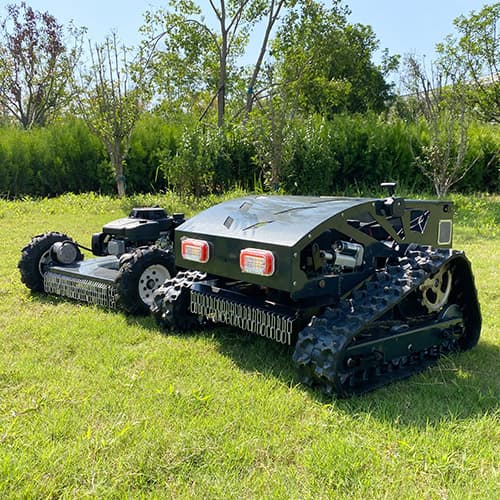

From Traditional Mowing to Smarter Land Management
Land maintenance is entering a new development phase. For decades, mowing and vegetation management have relied heavily on tractors, ride‑on mowers, walk‑behind machines and brush cutters. Though these traditional tools still deliver solid performance, professional land‑maintenance crews are facing increasingly diverse and complex job‑site conditions.
Steep slopes, rough grass, roadside vegetation, farmland, industrial sites, orchards and large estates all demand equipment capable of stable operation under varied conditions. Meanwhile, labor shortages, rising operating expenses, stricter safety standards and higher productivity expectations are reshaping purchasing decisions for commercial operators. This market shift fuels growing interest in tracked remote control mower and other intelligent land‑maintenance hardware.
Remote‑controlled machinery will not phase out conventional tools overnight. Instead, it becomes a vital component of the industry transition toward more flexible, tech‑enabled vegetation management workflows.
Why Terrain Is Driving Equipment Innovation
Field work rarely takes place on perfectly flat ground. Professional teams frequently encounter a wide range of challenging working scenarios.
Steep grass slopes
Roadside embankments
Drainage areas
Rough agricultural land
Orchards and plantations
Industrial properties
Large private estates
Construction sites
Overgrown vegetation areas
These sites create obvious pain‑points for standard mowing gear. Sloped terrain in particular places high requirements on traction, maneuverability, operator positioning and chassis stability. Remote‑control mowing systems offer an alternative operational model: operators stay at a safe observation spot with clear sightlines, while the machine handles incline mowing work. Compact units such as mini tank mower bring this flexibility to smaller, constrained slope assignments.
This separation between human operator and working machine delivers tangible advantages for locations hard to reach with walk‑behind or ride‑on equipment.
What Makes Remote Control Mowers Different?
A genuine professional remote control lawn mower is far more than an ordinary mower retrofitted with a wireless remote. Every subsystem must function as one unified integrated platform for real‑world field deployment.
Remote control technology
Drive system
Traction system
Cutting mechanism
Chassis design
Operator controls
Safety functions
Maintenance access
Power system
Machine monitoring features
Overall field performance is decided by how well these components cooperate. Impressive cutting power alone is not enough; buyers also need to evaluate cross‑terrain mobility, controller responsiveness, transport convenience and service friendliness. Future‑oriented land‑maintenance hardware focuses on full‑system performance rather than isolated fancy technical features.
Smart Equipment Is About More Than Automation
When “smart equipment” is mentioned, many people immediately think of fully autonomous robotic mowers. In fact, intelligent land‑maintenance covers a wide technology spectrum sitting between traditional manual machinery and complete hands‑off automation. Remote control represents one critical intermediate step.
Electronic control systems
Digital monitoring
Remote diagnostics
Automated safety functions
Improved operator interfaces
Machine condition monitoring
GPS‑based positioning
Data collection
Fleet management systems
These incremental upgrades help commercial equipment become easier to operate, supervise, service and integrate into existing business workflows. For contracting businesses, practical problem‑solving value always ranks higher than pure technical novelty.
Remote Control and Operator Positioning
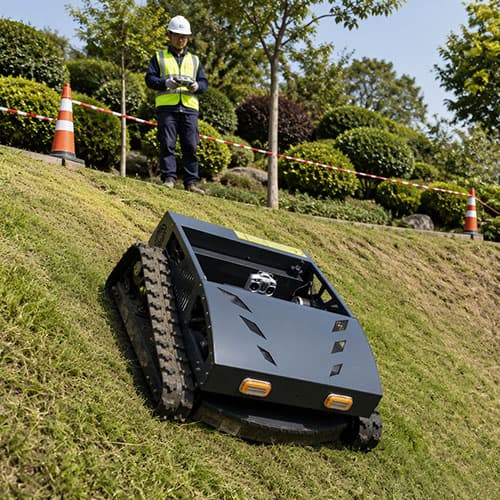
One core transformation brought by remote‑control mowing is flexible operator positioning. Ride‑on mowers require operators to sit onboard; walk‑behind models demand operators follow closely. With remote‑control units, crew members can stand on stable ground and supervise operations from an appropriate distance.
This advantage stands out especially on slopes and hard‑to‑access sites, granting operators clearer sightlines over the mowing path. Even so, remote operation cannot replace standard safety workflows. Operators still require proper training, thorough site assessment, constant visibility checks and adherence to safe working distances. Advanced technology supports good field practice instead of replacing human responsibility.
A New Approach to Professional Productivity
Industry productivity is frequently measured through mowing speed and cutting width. But real‑world commercial productivity has broader definitions. Great value comes from hardware that unlocks difficult assignments which otherwise demand extra labor, multiple machines or complex preparation work.
Take landscaping contractors managing mixed‑condition properties as an example: flat lawns and steep inclines coexist on the same jobsite. Trying to handle every zone with a single mower is rarely efficient. Building a diversified equipment fleet delivers much better returns.
| Working Environment | Suitable Equipment Approach | Main Consideration |
|---|---|---|
| Flat residential lawn | Walk‑behind mower | Precision and accessibility |
| Large open commercial lawn | Ride‑on mower | Coverage and efficiency |
| Steep grass slope | Remote control mower | Operator positioning and terrain capability |
| Rough agricultural land | Specialized mower | Traction and vegetation conditions |
| Roadside vegetation | Remote or specialized equipment | Access and operating environment |
| Large estate | Mixed equipment fleet | Flexibility across different areas |
Instead of counting on one universal machine, businesses ought to treat equipment as a complete system. You can browse our full RC mower lineup to build your diversified fleet configuration.
The Role of Remote Control Mowers in Agriculture
Agriculture represents another high‑potential market for remote‑control mowing technology. Farm sites commonly contain uneven ground, grassy inclines, orchard rows, field margins and narrow drainage zones where large tractors struggle to maneuver. Remote‑control mowing equipment fills this capability gap.
Orchard and plantation work demands outstanding maneuverability for operating between tree trunks. Models like robot crawler lawn mower are well‑suited for these tight‑space vegetation‑management assignments. These units complement existing farm machinery rather than replacing tractors, taking charge of specialized tasks requiring compact footprint and safe remote operator positioning.
The Importance of Smarter Maintenance
Future‑focused land maintenance is not only about upgraded mowing performance; intelligent maintenance workflows also grow more critical. Commercial enterprises lose revenue through unexpected equipment downtime, which disrupts project timelines, labor scheduling and client commitments. This makes preventive maintenance a core operational priority.
Next‑generation smart hardware can deliver real‑time data covering operating hours, service reminders, performance logs and remote diagnostic support. For manufacturers, selling machines evolves into delivering complete service ecosystems: technical guidance, spare‑parts supply, operator training plus machine performance analytics.
What Will Professional Buyers Look For?
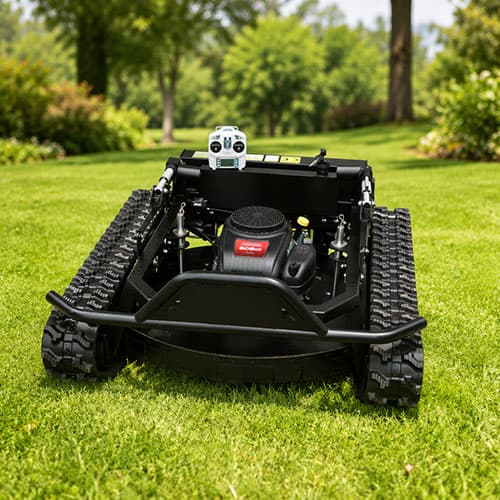
As industry technology evolves, purchasing evaluation standards shift away from pure horsepower parameters toward overall operational fit. Buyers will ask a set of comprehensive practical questions:
Terrain Capability: Can the machine handle typical jobsite conditions?
Control: Is remote‑control response reliable for daily professional work?
Maintenance: Can routine servicing be completed efficiently?
Transport: Is inter‑site equipment hauling convenient?
Support: Are spare‑parts and technical assistance accessible?
Integration: Can it merge smoothly with current equipment fleets?
Total Operating Value: Does it deliver tangible returns across its service life?
Remote Control Mowers and the Future of Labor
Labor recruitment and retention create persistent challenges for landscaping and land‑maintenance sectors worldwide. Even with advanced machinery, skilled human operators remain irreplaceable. Technology transforms how people complete tasks instead of eliminating manpower requirements entirely.
Remote‑control hardware enables qualified staff to supervise mowing work without physically riding or walking alongside the machine. As control interfaces and safety systems keep upgrading, operator roles gradually shift from manual physical operation toward managing sophisticated equipment systems. Human expertise judging terrain, vegetation, weather, obstacles and service needs cannot be automated. The future belongs to skilled people cooperating with high‑performance machinery.
What Could the Next Generation Look Like?
Upcoming professional mowing platforms will combine multiple technical innovations: enhanced monitoring modules, optimized traction management, digital remote diagnostics and more intelligent control logic. Operators receive real‑time machine status data from a safe observation position; fleet administrators can track usage metrics and service needs across multiple units.
Even with long‑term automation progress, product development must stay rooted in real‑world pain‑points. New technology only creates value when it solves practical jobsite challenges.
Why KOIVI Is Part of This Transition
KOIVI develops remote control lawn mowers built for professional land‑maintenance scenarios. Our product philosophy aligns with the wider industry shift seeking higher operational flexibility for demanding terrain. For contractors, property managers, agricultural operators and grounds‑maintenance crews, KOIVI remote‑control mowing delivers an extra tool for sites where conventional equipment shows limits.
These machines work as a complement to your existing fleet rather than a full replacement for traditional mowing gear. The future of professional vegetation management will not rely on one single machine category, but on adaptive fleets matched to diverse assignments. If you want to discuss technical requirements and fleet planning with our product specialists, you can get connected via WhatsApp.
Frequently Asked Questions
1. Are remote control mowers the future of professional land maintenance?
Remote control mowers are one part of the broader development of professional land maintenance equipment. They offer a different operating approach for slopes, rough terrain, and difficult‑access areas.
2. Are smart mowers fully autonomous?
Not necessarily. Smart equipment can include remote control, electronic systems, monitoring, diagnostics, and other technologies without being fully autonomous.
3. Can remote control mowers be used in agriculture?
Yes. Depending on the machine's design and specifications, remote control mowers can be suitable for certain agricultural applications, including grass management in orchards, plantations, slopes, and rough areas.
4. Will remote control mowers replace traditional lawn mowers?
Not necessarily. Different machines are suited to different environments. Remote control mowers can complement walk‑behind, ride‑on, and tractor‑based equipment.
5. What should professionals consider before buying a remote control mower?
Important factors include terrain, vegetation, traction, cutting requirements, remote control performance, transport, maintenance, spare parts, technical support, and operator training.
6. Is remote control mowing safer?
Remote operation can allow the operator to work away from the machine, which may be useful in certain environments. However, safety still depends on proper training, site assessment, machine condition, visibility, and operating procedures.
The Future Is Flexible, Connected, and Application‑Driven
Land maintenance is evolving from machine‑centric work toward technology‑empowered professional service. Remote‑control mowing forms an important component of this industry transition. It delivers practical solutions for tough terrain while paving the way for digital monitoring, remote diagnostics, optimized control systems and future automation functions.
For landscaping firms, agricultural operators and property managers, the core question is not whether every piece of equipment must become “smart”. The key lies in whether technology solves real‑world operational pain‑points. On many challenging sites, remote‑control mowing brings flexibility traditional mowing hardware cannot deliver.
Moving forward, successful land maintenance will combine skilled human operators, remote‑control machinery, intelligent monitoring systems and specialized equipment. KOIVI pushes professional mowing toward higher flexibility, tackling demanding terrain one jobsite at a time.