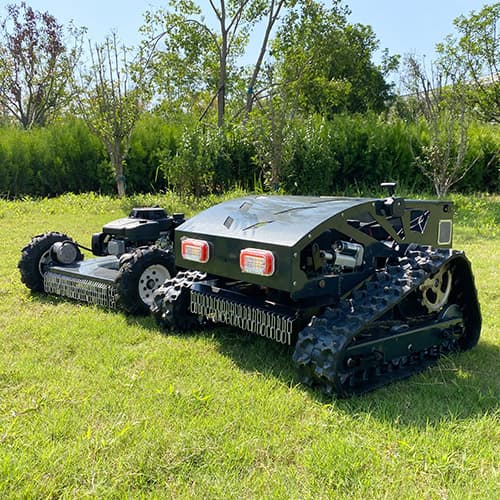

Across Europe and North America, the way professionals approach grass cutting and vegetation management is changing. From our communications with overseas distributors, we keep hearing consistent feedback from landscaping contractors facing real‑world site limitations day‑to‑day.
For decades, conventional walk‑behind mowers, ride‑on mowers, and tractors have been the standard tools for maintaining lawns, commercial properties, farmland, roadsides, and large outdoor spaces. These machines remain important, but they are not always the most practical choice for every environment.
Steep slopes, uneven ground, overgrown vegetation, orchards, embankments, and difficult‑to‑access areas continue to present challenges for landscaping contractors and property maintenance professionals.
This is one reason why interest in the remote control lawn mower is growing.
Remote controlled mowing equipment offers a different way to approach difficult terrain. Instead of requiring the operator to sit on the machine or walk directly behind it, the mower can be controlled from a distance.
For professional users in Europe and North America, this technology is becoming increasingly relevant as businesses look for equipment that can improve flexibility, reduce unnecessary physical demands, and handle more challenging outdoor environments.
The growing demand for remote control lawn mowers is not simply about new technology. It reflects a broader change in how professional mowing work is being planned and completed.
Why Traditional Mowing Equipment Is Not Always Enough
Conventional lawn mowers are highly effective in the right environment.
A ride‑on mower can be an excellent choice for maintaining large, relatively flat areas. A walk‑behind mower can be practical for smaller properties and detailed landscaping work.
However, many professional mowing jobs involve conditions that are far more complicated.
A maintenance contractor may be responsible for a property with steep embankments. A municipality may need to maintain roadside vegetation. An orchard owner may need to manage grass between rows of trees. A commercial landscaping company may work across dozens of properties with completely different terrain.
In these situations, conventional mowing equipment can have limitations.
The operator often needs to remain directly with the machine, which may not always be convenient when working on uneven or difficult terrain. Several contractors we have spoken with shared that working on steep slopes brings fatigue and safety concerns for their field crews.
This has created demand for alternative equipment designed specifically for more challenging environments.
A remote control lawn mower provides one of those alternatives.
Europe: A Strong Market for Specialized Mowing Equipment
Europe has a wide variety of landscapes and property types.
From agricultural land and vineyards to commercial estates, public parks, roadsides, and private properties, mowing requirements can vary significantly.
In many European regions, professional contractors are also expected to work efficiently within increasingly specialized maintenance operations.
This has contributed to growing interest in machines that are designed for specific applications rather than relying on one type of mower for every job.
Remote controlled lawn mowers can be particularly relevant in areas with:
Sloping terrain
Narrow access areas
Orchards and vineyards
Roadside embankments
Rough grassland
Commercial properties
Public infrastructure
Difficult vegetation management zones
The ability to operate a mower from a distance can give contractors more flexibility when approaching these environments.
Rather than positioning the operator directly on the machine, the remote control system allows the mower to be guided from a separate location.
For many professional users, that flexibility is becoming an increasingly important factor when choosing new equipment.
North America: Growing Demand for Efficient Grounds Management
The North American market presents a different set of opportunities. One of our Canadian distributors told us many local contracting businesses are actively seeking equipment to cut labour costs on slope‑related assignments.
Orchards and Agricultural Land
Agricultural users often need to manage grass and vegetation around trees and across uneven land.
Orchards can present access challenges that differ from open fields.
A remote control mower can provide a practical option for moving through grassed areas while allowing the operator to remain outside the immediate path of the machine.
Commercial Landscaping
Commercial landscaping companies often manage properties with different terrain conditions.
Instead of purchasing multiple machines for every possible situation, contractors increasingly look for equipment that can handle a wide range of applications.
Remote control technology provides an additional tool for these businesses.
Roadside and Infrastructure Maintenance
Roadside vegetation and infrastructure areas can be difficult to maintain using conventional equipment.
Slopes, uneven ground, limited access, and changing conditions can all affect how mowing work is completed.
Remote controlled mowers provide an alternative approach for contractors and maintenance teams working in these environments.
What Professional Buyers Are Looking For
The growing demand for remote control lawn mowers is not only about remote operation.
Professional buyers also consider the overall capability of the machine.
| Buyer Requirement | Why It Matters |
|---|---|
| Remote operating capability | Allows control from a distance |
| Terrain adaptability | Important for uneven ground |
| Reliable drive system | Supports movement through difficult areas |
| Cutting performance | Determines vegetation management capability |
| Easy maintenance | Helps reduce downtime |
| Durable construction | Important for commercial use |
| Transportation convenience | Useful for contractors working across multiple sites |
For buyers in Europe and North America, equipment selection is becoming increasingly application‑focused.
The question is no longer simply, "What is the biggest mower available?"
Instead, professional users are asking:
"Which machine is best suited to the jobs we actually perform?"
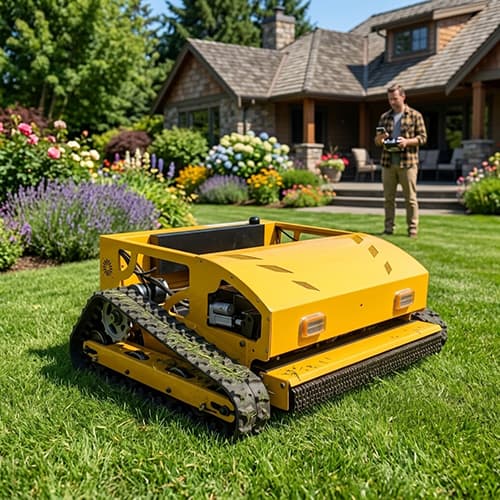
Remote Control Technology Is Changing the Operator's Role
One of the biggest differences between a conventional mower and a remote control mower is the position of the operator.
With traditional equipment, the operator normally moves with the machine.
With remote controlled equipment, the operator can guide the mower from another position.
This changes the working process.
The operator can observe the machine, monitor its movement, and select a position that provides a better view of the working area.
For complex terrain, this can provide additional flexibility.
The growing popularity of remote control technology in professional equipment reflects a wider trend across many industries.
Operators are increasingly using technology to control machines from positions that are better suited to the working environment.
Remote mowing equipment is part of this broader movement toward more flexible machine operation.
Comparing Remote Control Mowers With Conventional Equipment
Both types of equipment have their place.
The right machine depends on the job.
| Application | Remote Control Lawn Mower | Conventional Lawn Mower |
|---|---|---|
| Large flat lawn | Suitable | Often highly efficient |
| Steep slope | Strong application potential | Can be more challenging |
| Rough terrain | Designed for demanding environments | Depends on model |
| Overgrown vegetation | Suitable for specialized machines | Depends on equipment type |
| Complex commercial property | Flexible | May require multiple approaches |
| Specialist mowing projects | Useful | Depends on machine capability |
For many professional businesses, the future may involve using both types of equipment.
Remote control mowers are not expected to replace every conventional mower.
Instead, they are becoming part of a more specialized equipment strategy.
Labor Efficiency Is Becoming More Important
Across both Europe and North America, landscaping and grounds maintenance companies are under increasing pressure to improve operational efficiency.
Projects need to be completed on schedule.
Equipment needs to remain productive.
Teams need to handle a variety of work without carrying unnecessary machinery to every site.
A machine that can perform effectively across multiple challenging environments can therefore be valuable.
Remote control lawn mowers are attracting attention because they offer a different way to organize difficult mowing work.
Instead of requiring operators to approach every site in the same way, businesses can choose equipment based on the specific terrain and vegetation.
This flexibility can help contractors plan jobs more effectively. If you would like to go through your site‑based requirements with our engineering team, you can get connected via WhatsApp.
A Growing Market for Specialized Equipment
The professional mowing market is becoming more specialized.