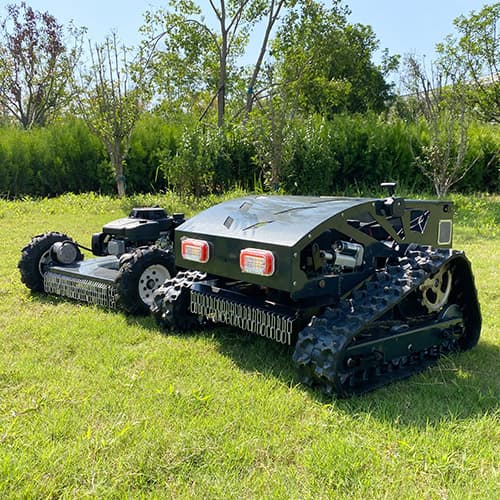

Professional landscaping has changed significantly over the last decade. From conversations with our overseas distributors, we hear that modern‑day contractors face wider‑ranging site demands compared to ten years ago.
The industry is no longer focused only on keeping lawns short and outdoor spaces visually attractive. Landscaping companies are now expected to manage large commercial properties, difficult terrain, roadside vegetation, estates, public spaces, agricultural land, and increasingly complex outdoor environments.
At the same time, contractors are under pressure to complete more work efficiently, manage labor costs, and choose equipment that can perform across different job sites.
This is where remote control lawn mowers are beginning to change the conversation.
Once considered a specialized type of equipment, remote controlled mowers are becoming increasingly relevant to professional landscaping companies. Their ability to operate on slopes, uneven ground, rough grass, and difficult‑to‑access areas gives contractors another option beyond conventional walk‑behind and ride‑on machines.
The biggest change is not simply that a mower can now be controlled with a remote.
The real change is in how landscaping professionals can approach difficult mowing jobs.
The Problem: Landscaping Jobs Are Becoming More Complex
A professional landscaping crew rarely works in the same environment every day.
A typical schedule may include a commercial property on Monday, a large private estate on Tuesday, a sloped embankment on Wednesday, and an overgrown property later in the week.
Each location presents different challenges.
Flat lawns are generally straightforward. However, many professional projects involve conditions such as:
Steep slopes
Uneven ground
Long or dense grass
Narrow access areas
Trees and obstacles
Roadside embankments
Rough commercial land
Drainage areas
Large properties with multiple terrain types
Mowing a slope is different from mowing a flat lawn.
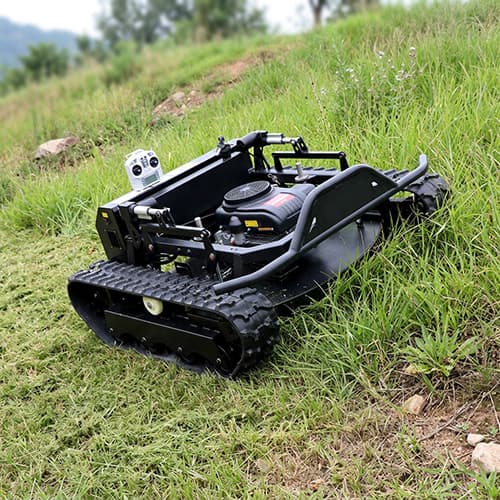
Ground conditions can change quickly, and the operator must continuously manage both the machine and the terrain. One landscaping contractor from France told us that their staff used to struggle with physical fatigue when handling repeated slope‑mowing assignments.
Remote operation provides another way to approach the job.
The mower can be guided from a separate location while the operator monitors its movement.
This makes remote controlled equipment particularly interesting for businesses that regularly maintain embankments and other difficult terrain.
For many contractors, the value is not that remote control replaces traditional mowing. It is that it provides an additional tool for jobs where conventional equipment may be less convenient.
Landscaping Is Moving Toward More Specialized Equipment
Professional landscaping companies are increasingly building more specialized equipment fleets.
Years ago, one or two types of mower may have handled most projects.
Today, contractors may use different machines depending on the job.
| Type of Work | Common Equipment Requirement |
|---|---|
| Flat commercial lawns | Conventional ride‑on mower |
| Detailed landscaping | Walk‑behind or compact mower |
| Large open areas | High‑capacity commercial mower |
| Steep slopes | Specialized terrain equipment |
| Rough grass | Heavy‑duty mowing equipment |
| Difficult terrain | Remote control lawn mower |
This trend toward specialization is helping drive interest in remote controlled mowing technology.
A remote mower does not need to replace every machine in a contractor's fleet.
Instead, it can fill a specific gap.
It provides an option for jobs where the terrain is too difficult, inconvenient, or time‑consuming for conventional equipment.
Improving Flexibility Across Different Job Sites
One of the biggest challenges for landscaping contractors is equipment flexibility.
A machine may perform extremely well on one job site and be unsuitable for the next.
Professional contractors therefore need to consider how equipment will fit into a wider range of applications.
Remote control lawn mowers are attractive because they can be used in multiple demanding environments.
Depending on the machine and configuration, common applications may include:
Sloped properties
Rough grassland
Orchards
Commercial sites
Industrial land
Embankments
Overgrown areas
Vegetation management projects
This versatility can be important for companies that work across different locations.
Instead of investing in a machine designed for only one highly specific application, contractors may look for equipment that can handle several types of challenging work.
The Operator Experience Is Changing
Remote control technology changes the relationship between the operator and the machine.
With traditional mowing equipment, the operator is physically connected to the working process.
They are either sitting on the machine or moving directly behind it.
With a remote controlled mower, the operator can work from another position.
This can provide a clearer view of the mower and the surrounding environment.
The operator can focus on:
The mowing path
Ground conditions
Obstacles
Changes in terrain
The overall working area
For professional landscaping teams, this can create a different type of workflow.
The operator is not simply moving with the mower.
They are actively managing the machine's movement from a position selected for the job.
This is one of the reasons remote controlled equipment is increasingly being considered for complex outdoor work.
Remote Control Mowers and Labor Efficiency
Labor efficiency is an important issue across the landscaping industry.
Contractors need to complete projects on schedule while managing equipment costs and staffing requirements.
The right equipment can help reduce unnecessary steps in the working process.
A remote control lawn mower can potentially help a team approach difficult terrain more efficiently by giving the operator greater flexibility in how the machine is positioned and controlled.
However, efficiency depends on the application. From our field‑testing records, we never promise universal time savings for every job site.
A remote mower may not be the fastest solution for a large, perfectly flat lawn.
That is not necessarily its purpose.
Its value becomes more obvious when conventional equipment requires additional positioning, repeated adjustments, or a different approach because of the terrain.
For contractors, the key is choosing the right machine for the right job.
Comparing Remote Control Mowers With Traditional Landscaping Equipment
Remote controlled mowing equipment is best understood as part of a professional equipment fleet rather than a complete replacement for traditional machines.
Both technologies have their place.
The growing popularity of remote control mowers does not mean that conventional mowing equipment is disappearing.
Instead, landscaping professionals are gaining more options.
More Demand for Difficult‑Terrain Solutions
One reason remote controlled mowers are becoming more popular is that difficult terrain is not disappearing.
Commercial developments continue to include landscaped slopes.
Roads and infrastructure require ongoing vegetation management.
Large estates often contain areas that are difficult to maintain with standard equipment.
Agricultural and rural properties may include uneven or overgrown land.
These applications require specialized solutions.
As a result, professional buyers are increasingly searching for equipment that can perform outside the traditional lawn mowing environment.
The term professional landscaping now covers much more than residential grass cutting.
It includes large‑scale property management, vegetation control, infrastructure maintenance, agricultural land management, and commercial grounds care.
Remote control lawn mowers fit naturally into this broader definition.
Software helps companies manage schedules.
GPS systems support equipment management.
Electric machines are becoming more common.
Automation is beginning to influence outdoor maintenance.
Remote controlled mowing equipment is another example of this technological shift.
The goal is not to make traditional landscaping equipment obsolete.
The goal is to provide additional tools for specific challenges.
For a professional landscaping company, having more equipment options means having more flexibility.
A conventional mower can handle open lawns.
A compact mower can work in tighter spaces.
A remote control mower can take on terrain that is more difficult to approach.
Together, these machines create a more adaptable equipment fleet.
How KOIVI Is Supporting the Changing Landscaping Industry
KOIVI develops remote control lawn mowers for professional users working in demanding outdoor environments.
The focus is on practical applications.
Professional customers need equipment that can operate in real working conditions—not simply perform well in ideal environments. Inside our factory, every unit goes through real‑condition simulation before shipment.
KOIVI remote controlled mowers are designed for applications involving:
Slopes and embankments
Rough terrain
Orchards
Dense grass
Commercial properties
Agricultural land
Vegetation management
By combining remote operation with purpose‑built mowing equipment, KOIVI provides professional users with another option for managing difficult terrain.
For landscaping contractors, the advantage is flexibility.
The ability to choose equipment based on the actual conditions of the job can help businesses expand the range of projects they are able to manage. If you want to discuss your project‑specific requirements, you can get connected via WhatsApp.
Frequently Asked Questions
What is a remote control lawn mower?
A remote control lawn mower is a mowing machine that can be operated using a handheld controller. The operator can guide the machine from a distance instead of sitting on it or walking directly behind it.
Why are remote control lawn mowers becoming popular in professional landscaping?
They are becoming more popular because professional landscapers increasingly work on slopes, rough terrain, overgrown areas, and other environments where conventional mowing equipment may be less practical.
Can a remote control mower be used on slopes?
Remote control lawn mowers are particularly relevant for challenging terrain, including slopes and embankments. The suitability of a specific machine depends on its design and the actual working conditions.
Do remote control mowers replace conventional lawn mowers?
No. Conventional mowers remain effective for many applications. Remote control mowers are typically used as an additional solution for difficult terrain and specialized mowing work.
Who should consider using a remote control lawn mower?
Landscaping contractors, property maintenance companies, agricultural users, estate managers, vegetation management teams, and commercial grounds maintenance businesses may benefit from remote controlled mowing equipment.
The Future of Professional Landscaping Is About Having More Options
Professional landscaping is becoming more complex, not less.
Contractors are working across more diverse environments, managing more demanding terrain, and searching for ways to operate more efficiently.